**Medical Disclaimer**: This article is for informational purposes only and does
not constitute medical advice. If you suspect bed bug bites or have a skin
reaction, consult a healthcare professional or licensed pest control operator.
You wake up with red, itchy welts on your arms. You find tiny, brownish
creatures in your bedding. Your first thought: *bed bugs*. But before you spend
thousands on heat treatments and throw out your mattress, know this — **what you
found might be carpet beetle larvae**, and the solution is very different.
Mistaking carpet beetle larvae for bed bugs is one of the most common pest
identification errors in households. The consequences of getting it wrong range
from wasted money (unnecessary exterminator visits) to prolonged suffering
(treating for the wrong pest while the real one thrives).
This guide will give you a side-by-side comparison so you can confidently
identify which pest you’re dealing with — in under 5 minutes.
Quick Comparison: 5-Second Identification
If you only remember one thing from this guide, make it this:
| Feature | Carpet Beetle Larva | Bed Bug |
| Body shape | Carrot-shaped, wider at middle | Flat, oval, apple-seed shaped |
|---|---|---|
| Hairs/Bristles | Dense tufts of visible hairs | No visible hairs, smooth |
| Movement | Crawls slowly, visibly hairy | Crawls steadily, smooth |
| Color | Tan/brown with lighter and darker bands | Uniform reddish-brown |
| Size | 4–8 mm (up to 1/3 inch) | 1.5–5 mm (poppy seed to apple seed) |
| Found in | Closets, drawers, carpet edges, under furniture | Mattress seams, bed frame, headboard |
| “Bites” | Skin irritation from larval hairs (not true bites) | True bites — pierce skin to feed on blood |
| Active when | Day and night, prefer darkness | Mostly at night |
Carpet Beetle Larvae: What They Look Like
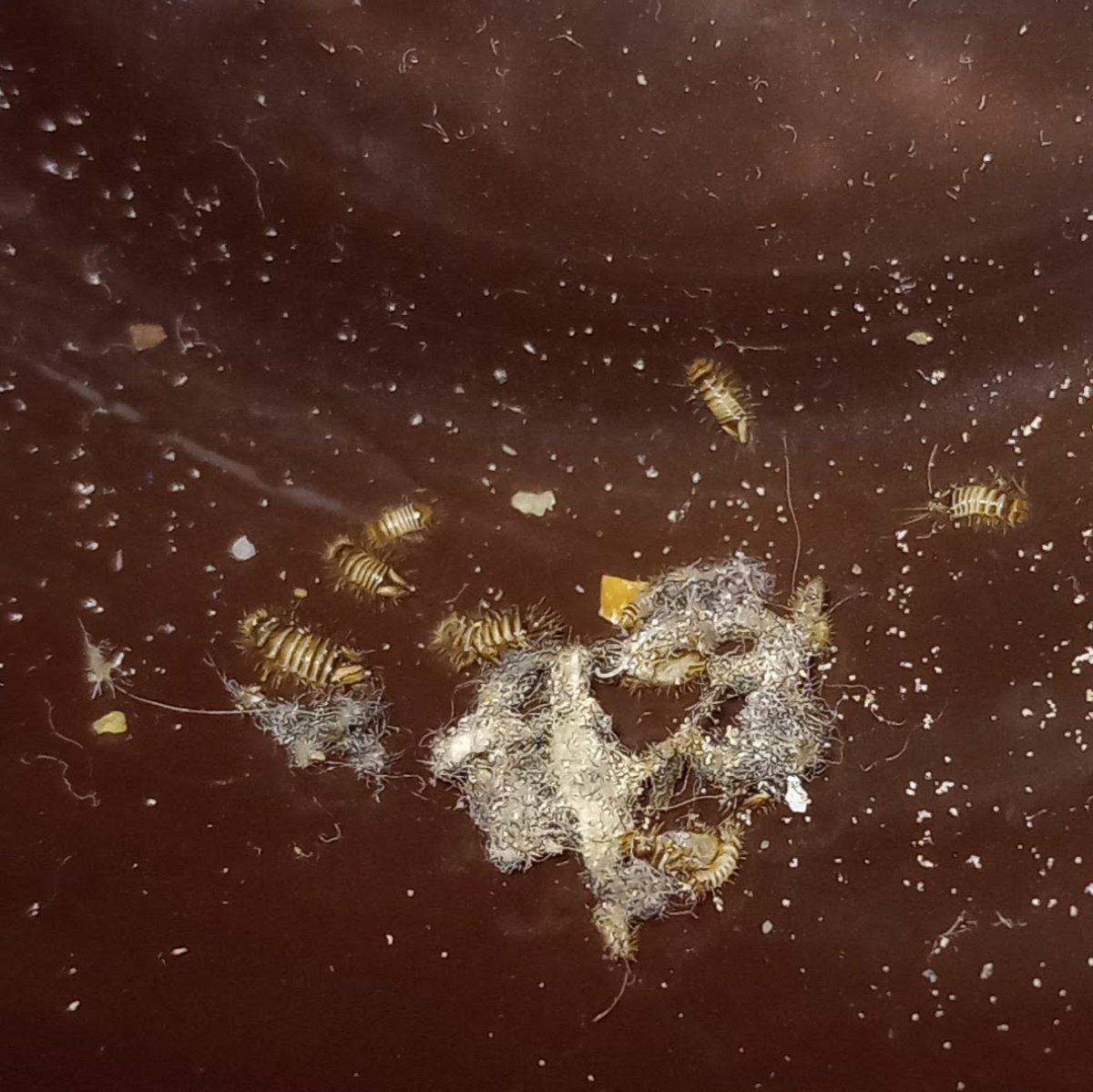
*Caption: A varied carpet beetle larva (Anthrenus verbasci). Note the carrot shape,
alternating light and dark brown bands, and the distinctive tuft of bristles at
the tail end.*
Carpet beetle larvae are often described as looking like tiny, fuzzy
caterpillars. Key identification points:
- **Body shape**: Elongated and slightly tapered at both ends — often compared
to a carrot or a tiny pine cone.
- **Banding**: Alternating light tan and dark brown bands run across the body.
- **Bristles**: The most distinctive feature — dense tufts of spear-shaped
hairs (setae) cover the body, with a prominent cluster of longer bristles at
the tail end.
- **Size**: 4–8 mm when fully grown, roughly the size of a grain of rice.
- **Movement**: Slow crawlers. When disturbed, they may curl up slightly.
Where You’ll Find Them
Carpet beetle larvae feed on **natural fibers and animal products** — not blood.
Look for them in:
- Wool carpets and rugs (especially edges and under furniture)
- Closets (feeding on wool, silk, feather-filled items)
- Upholstered furniture (feeding on hair, dander, and fabric)
- Pet bedding and areas where pet hair accumulates
- Behind baseboards where lint and debris collect
Bed Bugs: What They Look Like
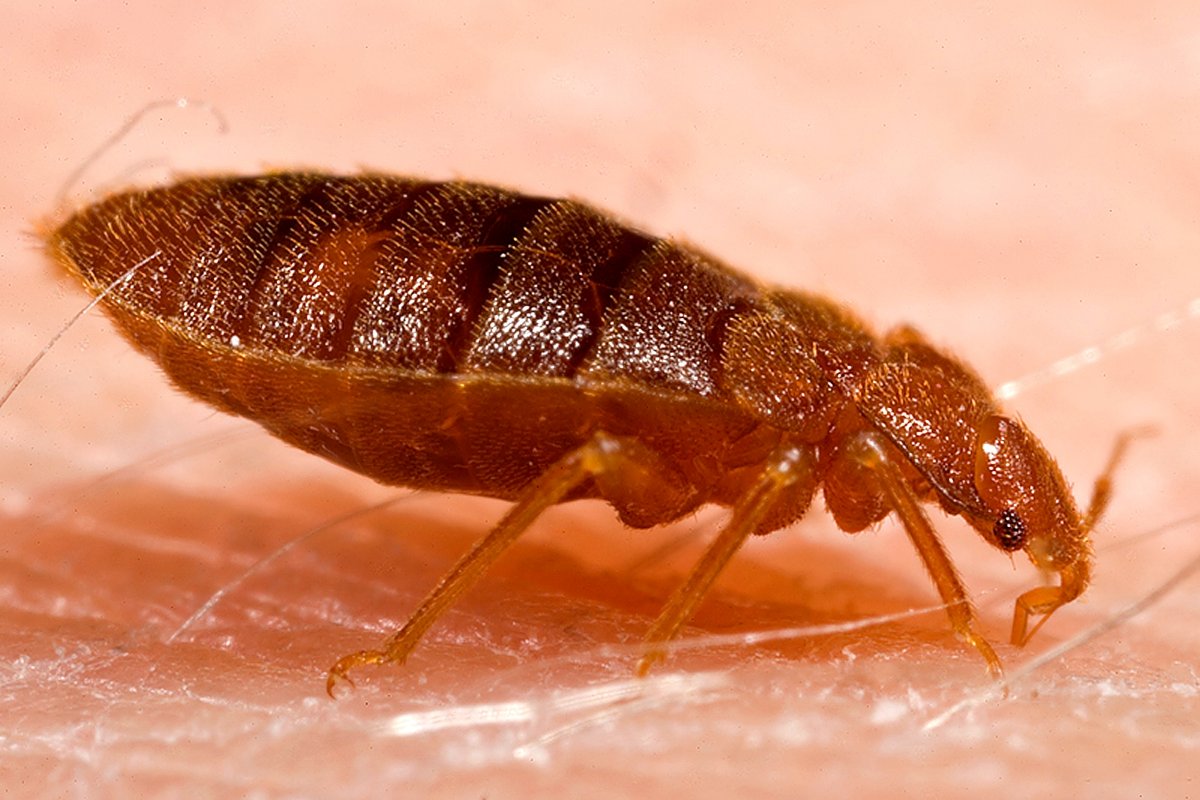
*Caption: An adult bed bug (Cimex lectularius). Note the flat, oval body, uniform
reddish-brown color, and the absence of visible hairs.*
Unlike carpet beetle larvae, adult bed bugs have:
- **Body shape**: Flat, broad, oval — like an apple seed with legs. After
feeding, the abdomen swells and becomes elongated and darker.
- **Color**: Uniform reddish-brown. Darker (almost purplish) after a blood meal.
- **Surface**: Smooth and shiny — no visible hairs or bristles to the naked eye.
- **Size**: 1.5–5 mm as adults. Nymphs are smaller (1–2 mm) and
translucent/yellowish.
- **Movement**: Steady crawlers. Not fast but deliberate.
Where You’ll Find Them
Bed bugs feed exclusively on **blood**. They stay close to their food source
(you):
- Mattress seams, tufts, and folds
- Box spring crevices
- Bed frame joints and headboard cracks
- Nightstands and baseboards near the bed
- Behind peeling wallpaper near sleeping areas
**Key tell**: Look for small black or rusty spots (fecal matter) on mattress
seams and bedding — this is a definitive sign of bed bugs that carpet beetle
larvae never produce.
The “Bite” Confusion: Why People Mix Them Up
This is where the two pests most often get confused — and it’s important to
understand the difference.
Carpet Beetle “Bites” (Actually Irritation)
Carpet beetle larvae **do not bite**. They don’t feed on blood, and they have no
reason to pierce human skin. However, the spear-shaped hairs (hastisetae) on
their bodies can cause:
- **Contact dermatitis**: Red, itchy rash where skin touched the larvae or shed
larval skins
- **Papular urticaria**: Small, raised bumps that resemble mosquito or bed bug
bites
- **Symptoms**: Usually appear on exposed skin (arms, neck, face) and may
persist for days to weeks
The irritation is an **allergic reaction** to the larval hairs — not a bite. Not
everyone reacts; some people have no symptoms at all, while others develop
significant rashes.
Bed Bug Bites (True Bites)
Bed bugs actively **pierce skin to feed on blood**, typically:
- **Pattern**: Often appear in lines or clusters of 3 (“breakfast, lunch,
dinner” pattern)
- **Location**: Any exposed skin during sleep — arms, shoulders, neck, face, legs
- **Timing**: Bites are painless at first; itching and welts appear hours to
days later
- **Duration**: Usually resolve within 1–2 weeks without treatment
Quick Test: Which Is It?
| Question | If Carpet Beetle Larva | If Bed Bug |
| Did you find the bug in your mattress? | Probably not — it’s in the carpet/closet | Very likely — mattress seams are prime habitat |
| Does the bug have visible hairs? | Yes — fuzzy/banded appearance | No — smooth and flat |
| Are there black spots on your mattress? | No | Often yes (fecal spots) |
| Was the bug crawling during the day? | Possible — they’re not strictly nocturnal | Unusual — bed bugs prefer darkness |
| Do symptoms follow a “line of 3” pattern? | No — scattered or random | Often yes |
What to Do If You Find Carpet Beetle Larvae
Good news: carpet beetle larvae are **not a health threat** in the way bed bugs
are. They don’t transmit disease. They don’t feed on you. But they can damage
your belongings.
- **Identify and remove the food source**: Vacuum thoroughly, especially carpet
edges, closets, and under furniture. Dispose of the vacuum bag immediately.
- **Wash affected fabrics**: Hot water + high heat dryer cycle for clothing,
bedding, and linens.
- **Steam clean**: Carpet beetle larvae and eggs die at 120°F (49°C). Steam
cleaning carpets and upholstery is highly effective.
- **Seal or discard infested items**: Heavily infested wool items, hides, or
taxidermy may need to be discarded or professionally treated.
For a complete step-by-step guide, see our [carpet beetle elimination guide](/how-to-get-rid-of-carpet-beetles/).
What to Do If You Find Bed Bugs
If you confirm it’s bed bugs, act fast — they multiply quickly.
- **Don’t move to another room**: You’ll spread them. Sleep in the infested
room until treatment is complete.
- **Wash and heat-dry**: All bedding, clothing, and curtains on the highest
heat setting.
- **Vacuum and steam**: Mattress, box spring, bed frame, baseboards.
- **Encasements**: Seal your mattress and box spring in bed-bug-proof covers.
- **Call a pro**: DIY bed bug treatment has a high failure rate. Professional
treatment (heat or chemical) is strongly recommended.
Summary: 3-Step Identification Protocol
- **Look at the bug**: Hairy and banded? → Carpet beetle larva. Smooth and flat?
→ Probably bed bug.
- **Look at where you found it**: In the carpet, closet, or on wool? → Carpet
beetle larva. On the mattress, bed frame, or near where you sleep? → Bed bug
is more likely.
- **Look for supporting evidence**: Black fecal spots on mattress? → Bed bugs.
Damaged wool sweater or shed larval skins? → Carpet beetles.
Frequently Asked Questions
Can carpet beetle larvae live in my bed?
Yes, but not for the reason bed bugs do. Carpet beetle larvae may end up in your
bed if there are natural fiber bedding (wool blankets, feather pillows) or if
they wander in from nearby infested carpets. They are not there to feed on you.
Do carpet beetle larvae bite at night?
No. Carpet beetles do not bite at all. If you’re being bitten at night, it’s
more likely bed bugs, fleas, or mosquitoes. The “bites” associated with carpet
beetles are skin irritation from contact with larval hairs.
Can I treat carpet beetles and bed bugs the same way?
No. Bed bug treatment targets blood-feeding insects near sleeping areas. Carpet
beetle treatment targets fabric-feeding larvae in carpets and closets. The
chemicals and methods differ significantly.
How did carpet beetle larvae get in my house?
Adults fly in through open windows and doors in spring/summer, attracted to
light. They lay eggs on natural fiber materials. The larvae are what you find
indoors — adults usually try to get back outside.
Related Guides
- [How to Get Rid of Carpet Beetles: Complete Guide](/how-to-get-rid-of-carpet-beetles/)
- [Carpet Beetle Rash: Symptoms & Treatment](/carpet-beetle-rash/)
- [Silverfish Identification Guide](/silverfish-identification/)
- [How to Get Rid of Drain Flies Forever](/how-to-get-rid-of-drain-flies/)
**Medical Disclaimer**: This article describes common presentations of carpet
beetle-related skin irritation and bed bug bites for identification purposes.
Skin reactions vary by individual. Consult a dermatologist for persistent or
severe rashes, and a licensed pest management professional for confirmed bed bug
infestations.