**Affiliate Disclosure**: When you buy through links on this page, we may earn
a commission. [Learn more](/affiliate-disclosure/)
You found a strange, silvery bug in the bathroom. It moved fast — almost
slithered — and disappeared before you could get a good look. Now you’re
wondering: was that a silverfish? Is it something worse? Should you be worried?
This guide will help you identify silverfish with confidence, tell them apart
from look-alikes, recognize the signs of an infestation, and understand when
you need to take action.
What Do Silverfish Look Like?
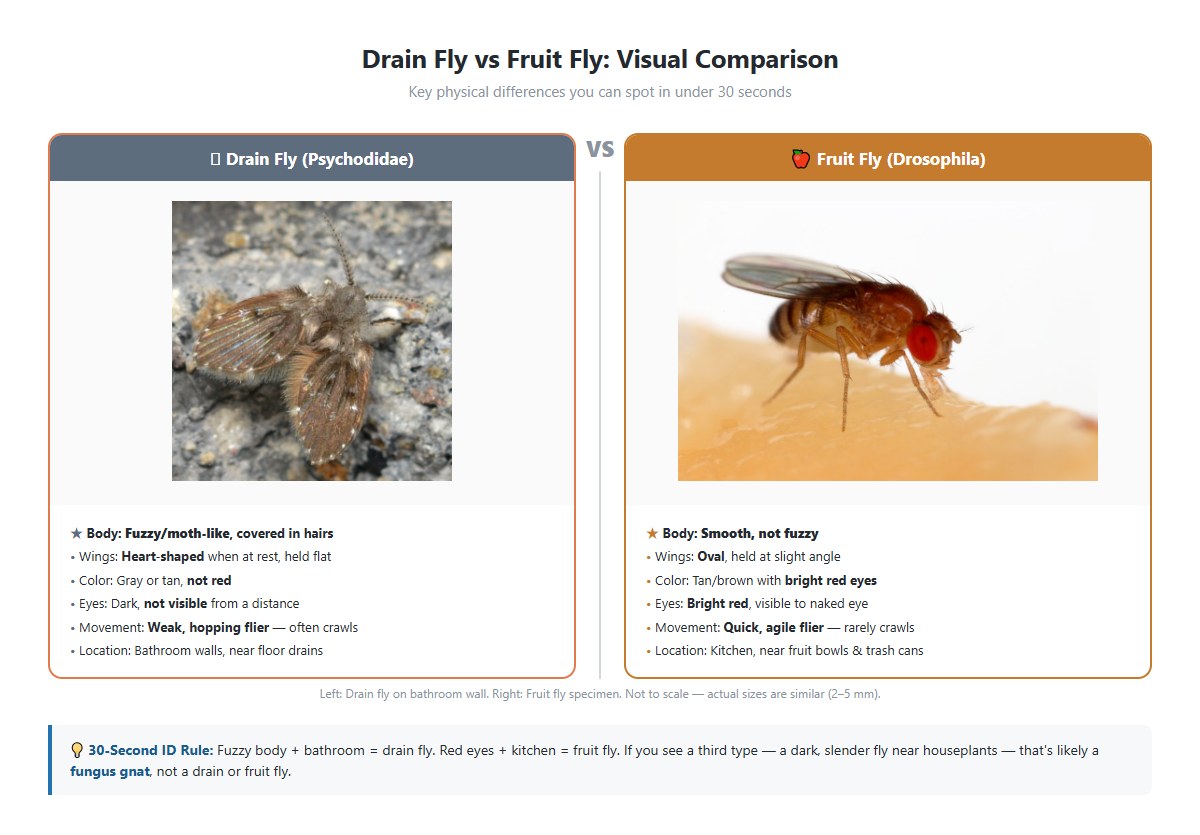
body segments, three tail appendages (cerci + terminal filament)]**
Silverfish have a distinctive, almost alien appearance. Once you know the key
features, they’re hard to confuse with anything else.
| Feature | Description |
| Body shape | Teardrop-shaped, tapering from head to tail; flattened top-to-bottom |
|---|---|
| Size | 12–19 mm (0.5–0.75 inches) as adults, excluding tail appendages |
| Color | Silvery-gray to blue-gray with a metallic sheen; younger silverfish are whitish |
| Texture | Covered in tiny silvery scales (like a fish) that rub off when touched |
| Antennae | Two long, thin antennae at the head; as long as or longer than the body |
| Tail appendages | Three hair-like structures at rear — two cerci (side) + one terminal filament (center) |
| Eyes | Two small compound eyes on the sides of the head |
| Legs | Six short legs; they can run surprisingly fast |
| Wings | None — silverfish are wingless (a key difference from some look-alikes) |
The “Fish-Like” Movement
Silverfish move with a distinctive wriggling, fish-like motion — hence the
name. They can run rapidly across flat surfaces, but unlike roaches, they
don’t scatter in all directions when exposed to light. Instead, they typically
freeze briefly, then make a fast, straight dash for the nearest dark crevice.
Silverfish Life Stages: What You Might See
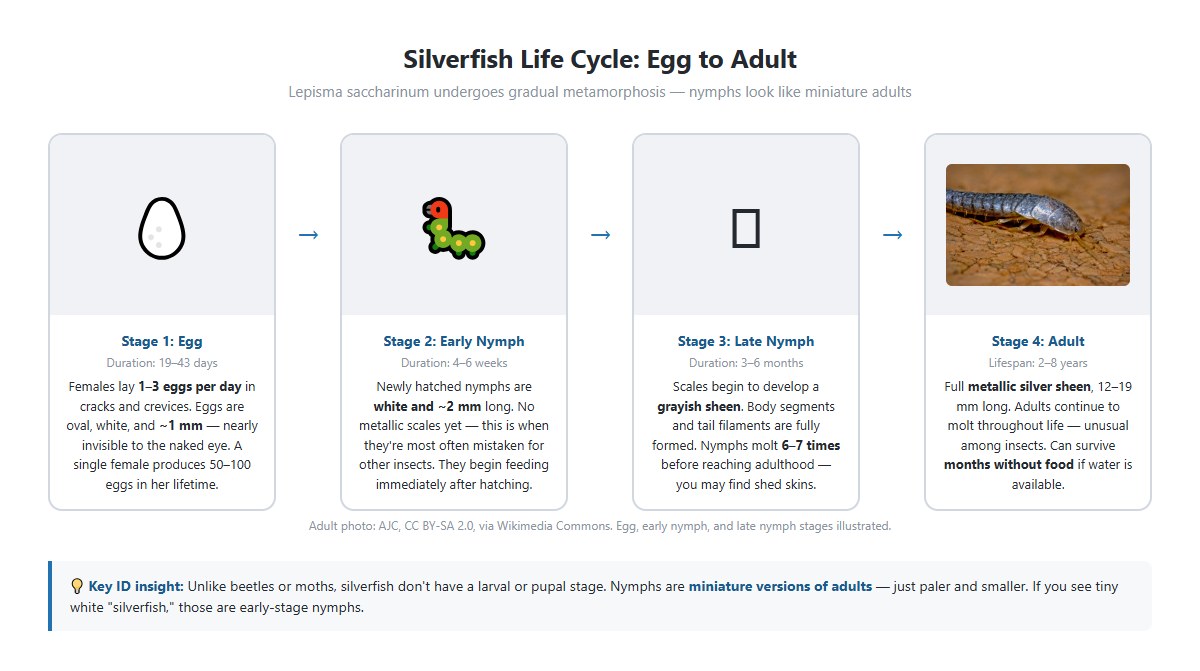
adult (metallic silver) side by side]**
| Stage | Size | Color | Notes |
| Egg | ~1 mm | White, oval | Laid in cracks and crevices; hatch in 19–43 days |
|---|---|---|---|
| Nymph (newly hatched) | 2–3 mm | White, almost translucent | Looks like a tiny white adult; hard to spot |
| Juvenile | 5–10 mm | Pale gray, developing metallic sheen | Multiple molts over 3–24 months |
| Adult | 12–19 mm | Silvery-gray with metallic sheen | Can live 2–8 years; continues to molt throughout life |
Unlike most insects, silverfish continue to molt even after reaching adulthood
— sometimes 50+ times in their lifetime. If you find shed exoskeletons
(which look like translucent, hollow silverfish), that’s a sign of an active
population.
Silverfish vs Firebrat: The Most Common Mistake
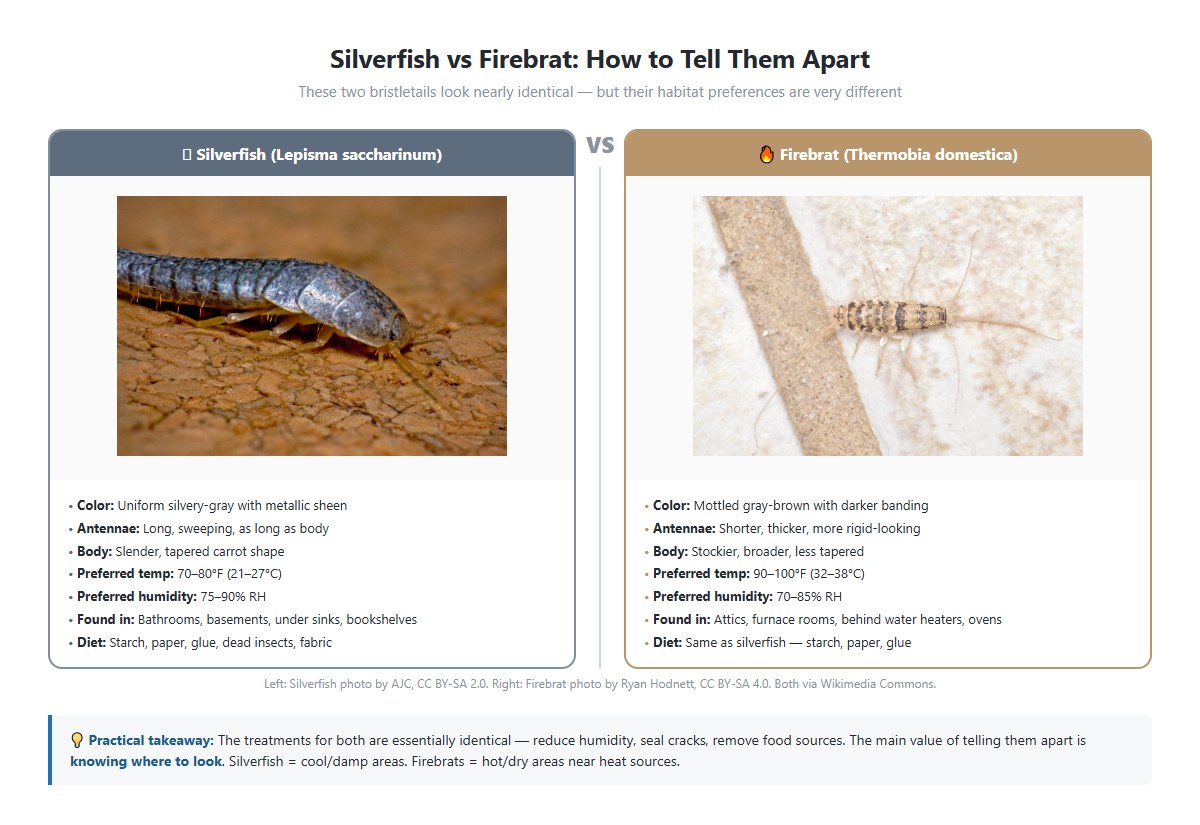
Silverfish and **firebrats** (*Thermobia domestica*) are close relatives and
look very similar. Here’s how to tell them apart:
| Feature | Silverfish | Firebrat |
| Color | Silvery-gray, blue-gray | Mottled gray-brown with darker bands |
|---|---|---|
| Size | 12–19 mm | 10–15 mm (slightly smaller) |
| Preferred temperature | Room temp (70–80°F) | Hot (90–100°F+) |
| Where found | Bathrooms, basements, living spaces | Near furnaces, water heaters, boiler rooms, attics |
| Body pattern | Uniform metallic sheen | Irregular dark markings/bands on back |
| Antennae | Longer than body | Longer than body (similar) |
**Quick rule**: If you’re seeing it in a normal-temperature bathroom →
**silverfish**. If you’re seeing it near a furnace or hot water heater →
**firebrat**.
The good news: treatment is nearly identical for both. If you use the methods
in our [silverfish elimination guide](/how-to-get-rid-of-silverfish/), either
pest will be eliminated.
Signs of a Silverfish Infestation
Seeing one silverfish doesn’t necessarily mean you have a problem. Here’s how
to gauge the severity:
Early Warning Signs
| Sign | What to Look For | Severity |
| Irregular holes in paper | Books, magazines, documents with small, irregular feeding holes | Light infestation |
|---|---|---|
| Yellow stains | Yellowish stains or “scales” left behind on fabric, paper, or walls | Light to moderate |
| Shed skins | Translucent, hollow silverfish-shaped exoskeletons in corners or under furniture | Active infestation |
| Black pepper-like droppings | Tiny, dark specks (feces) on surfaces where silverfish travel | Moderate infestation |
| Live sightings during the day | Multiple silverfish seen during daylight hours | Moderate to heavy infestation |
Silverfish Damage: What to Check
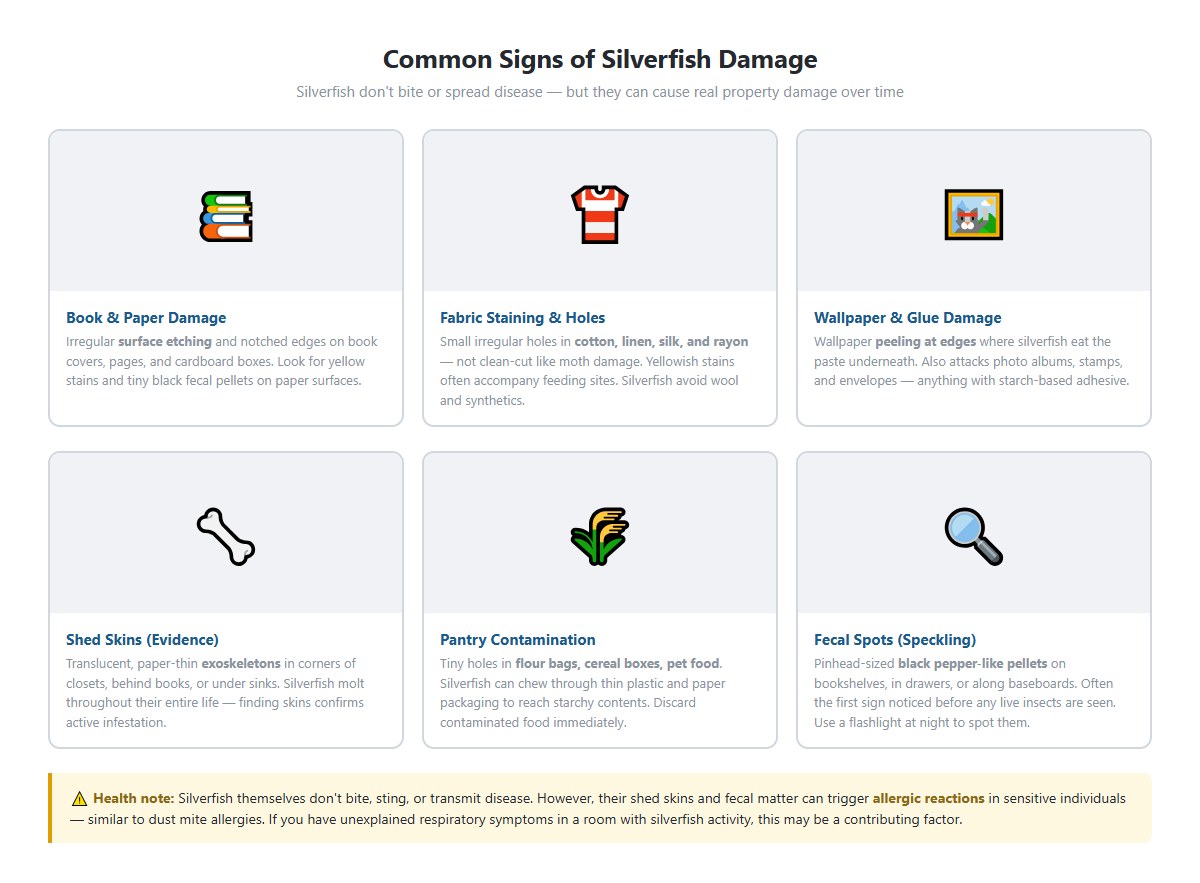
wallpaper with surface damage, fabric with feeding marks]**
Check these items for damage:
- **Books**: Look at the spine and cover edges. Silverfish often feed on the
glue in book bindings and the starch in paper coatings.
- **Wallpaper**: Look for irregular surface damage or peeling edges — they’re
eating the paste behind the paper.
- **Stored clothing**: Check natural fiber items (cotton, linen, silk) stored
in humid closets or basements. Look for irregular holes and yellow stains.
- **Important documents**: Stored files, old photographs, and memorabilia in
cardboard boxes are highly vulnerable.
- **Pantry items**: Flour, cereal, and dry pet food in non-airtight containers.
Where to Look for Silverfish During the Day
Silverfish are nocturnal. During the day, they hide in dark, humid, tight
spaces. If you’re trying to confirm an infestation, search these areas with a
flashlight:
**High-probability locations**:
- Behind and under bathroom sink cabinets
- Inside the gap between the toilet and the wall
- Under the lip of bathtubs and shower pans
- Inside linen closets (especially on lower shelves)
- Behind books on bookshelves (especially lower shelves near exterior walls)
**Medium-probability locations**:
- Behind kitchen appliances (refrigerator, dishwasher)
- Inside kitchen cabinets under the sink
- Basement corners, especially near floor drains
- Inside cardboard boxes stored on basement or garage floors
**How to search effectively**: Move furniture slowly, shine a flashlight at
baseboard level, and look for movement. Silverfish freeze when exposed to
light, so pause and watch for 5–10 seconds after illuminating an area.
When to Take Action
| Situation | Action |
| 1–2 silverfish seen, no damage | Monitor; reduce humidity in that room |
| Silverfish seen weekly, minor damage found | Start moisture control + DE treatment |
| Multiple silverfish nightly, visible damage | Full elimination protocol (see our guide) |
| Extensive damage to valuable items | Full protocol + consider professional treatment |
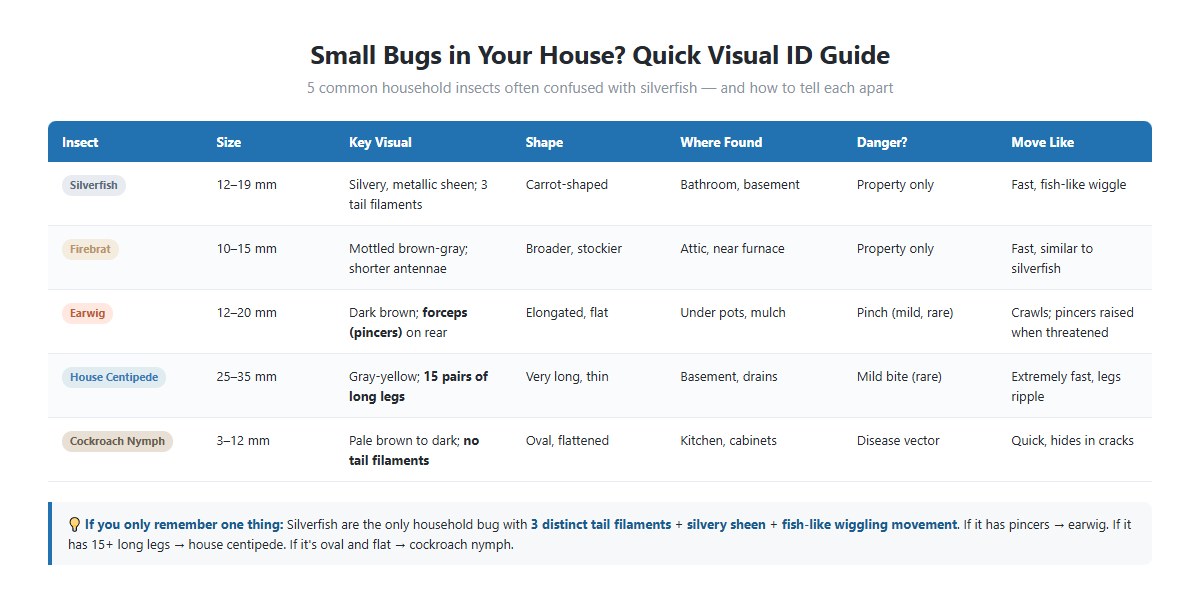
Not a Silverfish? Other Common Look-Alikes
| Pest | Key Differences from Silverfish |
| Firebrat | Mottled brown-gray, found in hot areas, otherwise identical body shape |
|---|---|
| House centipede | Many more legs (15 pairs), much faster, predatory (they hunt other bugs) |
| Earwig | Has pincers (cerci) at rear that curve inward; dark brown, not silver |
| Carpet beetle larvae | Hairy/fuzzy appearance, rounded body, slow moving — completely different shape |
| Roach nymph | Oval body, not teardrop-shaped; usually brown; runs faster |
Next Steps
- **Confirmed silverfish?** → [How to Get Rid of Silverfish: A Step-by-Step Guide](/how-to-get-rid-of-silverfish/)
- **Still not sure what you have?** → [Small Bugs in Your House? Visual Identification Guide](/small-bugs-in-house-identification/)
Related Guides
- [How to Get Rid of Silverfish: Step-by-Step Guide](/how-to-get-rid-of-silverfish/)
- [Natural Silverfish Remedies That Actually Work](/natural-silverfish-remedy/)
- [Best Silverfish Killer Products: Sprays, Traps & Natural Options](/best-silverfish-killer/)
- [Home Pest Prevention Checklist](/home-pest-prevention-checklist/)