**Affiliate Disclosure**: When you buy through links on this page, we may earn
a commission. This does not affect our recommendations. [Learn more](/affiliate-disclosure/)
You walk into your bathroom, flip on the light, and there they are — tiny,
fuzzy, moth-like bugs resting on the wall near the sink. You swat one. Tomorrow,
there are three more. You clean the bathroom. Next week, they’re back.
**Drain flies** (also called moth flies, sewer flies, or filter flies) are
persistent. They don’t respond to regular fly swatters. They don’t care about
your cleaning routine. And if you don’t address the *source*, they will keep
coming back indefinitely.
This guide will walk you through exactly how to identify drain flies, find
their breeding site, eliminate the current infestation, and prevent them from
ever returning.
What Are Drain Flies?
Drain flies (*Psychodidae* family, most commonly *Clogmia albipunctata* in
homes) are small true flies that breed in the organic sludge that builds up
inside household drains.
| Characteristic | Drain Fly | Fruit Fly | Fungus Gnat |
| Size | 1.5–5 mm | 2–3 mm | 2–3 mm |
| Body shape | Fuzzy, moth-like, heart-shaped wings | Round, tan/brown body | Thin, mosquito-like, black body |
| Where found | Bathroom/kitchen drains, sink edges | Near fruit, garbage, fermenting food | Houseplant soil |
| Flight pattern | Weak, short hops | Erratic, fast | Slow, weak near plants |
| Key identifier | Fuzzy appearance, wings held flat like a roof when resting | Red eyes | Dark body, long legs, clear wings in Y-shape |
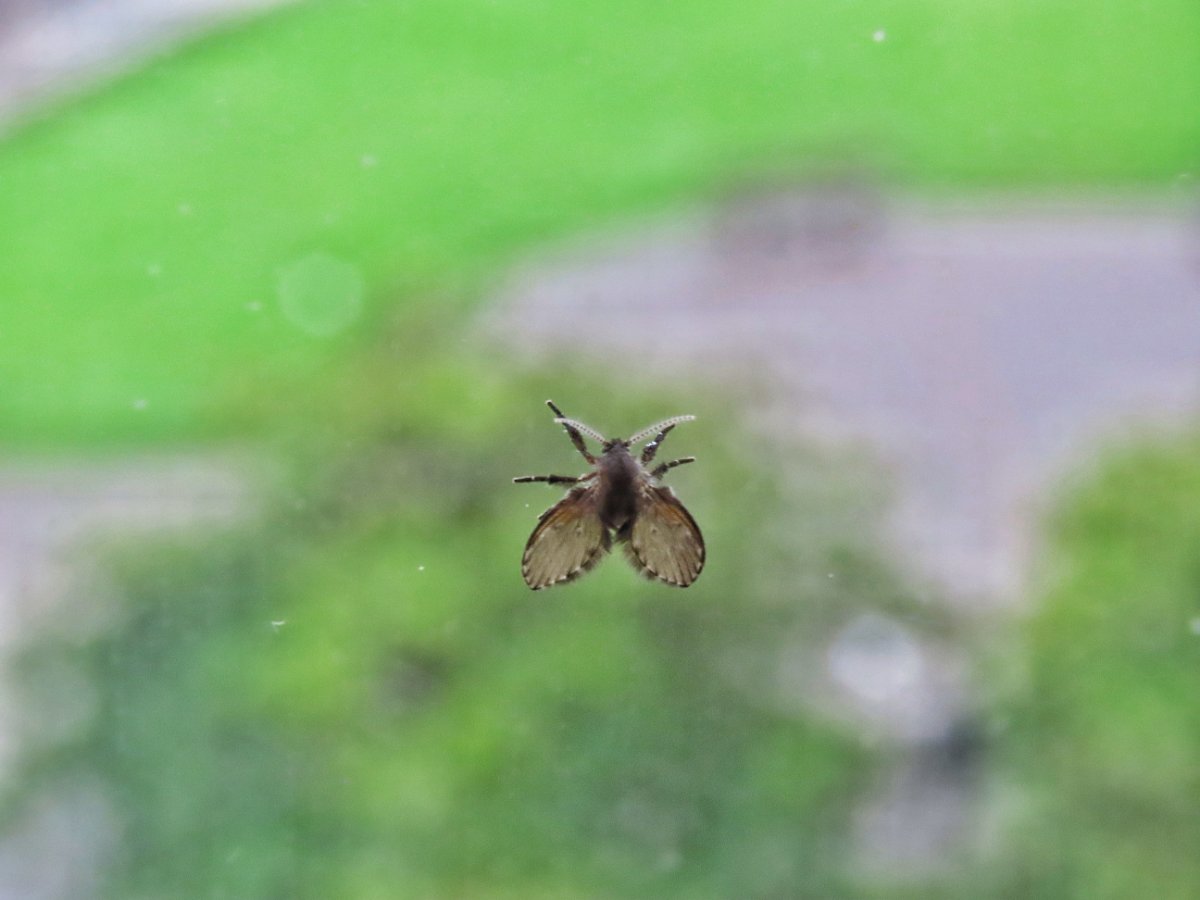
*Caption: A drain fly (Clogmia albipunctata). Note the fuzzy body and distinctive
wing shape held flat over the back — this is the easiest way to distinguish
drain flies from fruit flies and fungus gnats.*
The Drain Fly Life Cycle
Understanding the life cycle is the key to elimination:
- **Eggs** (laid in drain sludge): 10–200 eggs, hatch in ~48 hours
- **Larvae** (live in the drain film): 9–15 days, feeding on organic matter
- **Pupa** (in the drain): 1–2 days
- **Adult** (the ones you see): Live 2–3 weeks, can lay eggs within 24 hours
of emerging
This is why spraying adult flies doesn’t solve the problem. A single female
can lay up to 200 eggs in the drain film. You kill 10 adults today, and 50 new
ones emerge from the drain tomorrow.
Why Do You Have Drain Flies?
Drain flies appear when there is **stagnant water containing decaying organic
matter** inside a drain. Specifically, they need:
- The **gelatinous film** that builds up on the inside walls of drain pipes
- This film is made of hair, soap scum, skin cells, and bacteria
- Stagnant or slow-moving water allows the film to accumulate
Where to Look First
| Location | Risk Level | Why |
| Bathroom sinks | High | Soap scum + hair + standing water in P-trap |
|---|---|---|
| Shower drains | High | Hair + soap + skin cells = perfect breeding medium |
| Kitchen sinks | Medium | Food particles + grease + soap |
| Floor drains | Medium | Often unused, water evaporates from P-trap |
| Toilet (rarely used) | Low | Only if unused long enough for P-trap to dry out |
| AC condensate drain | Low | Can breed if clogged |
| Leaky pipes under sink | Possible | Standing water in cabinet |
How to Confirm the Source
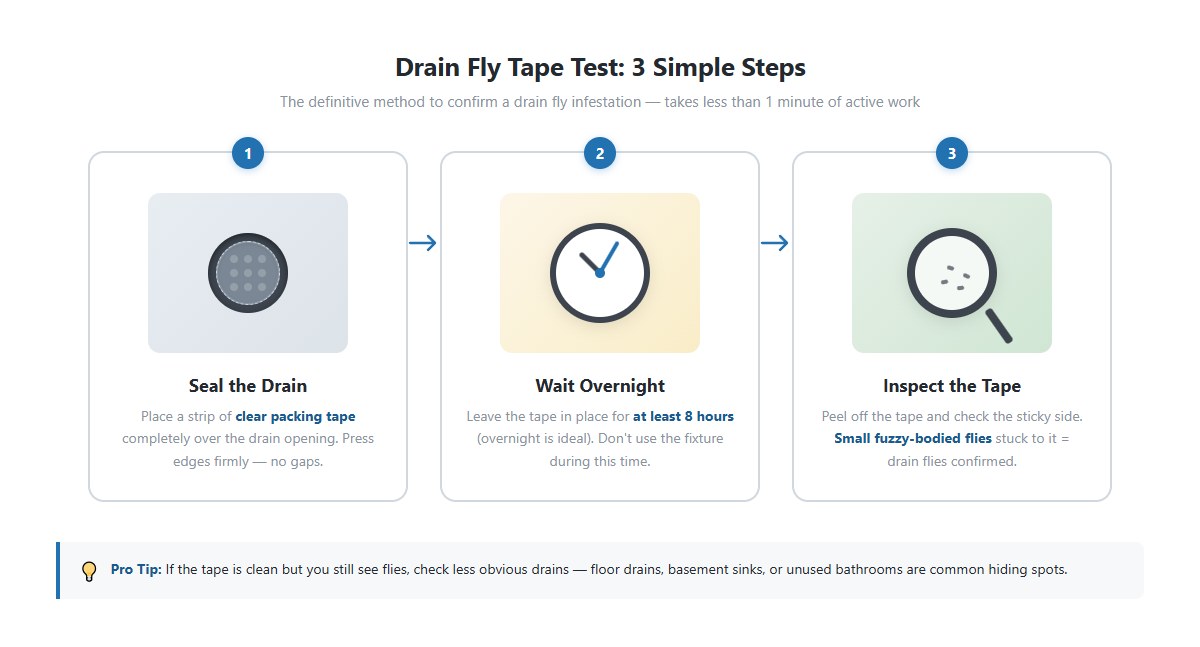
**The Tape Test** — the single most reliable method:
- Take clear packing tape or duct tape
- Cover the drain opening completely (don’t seal — leave a gap for air)
- Leave it overnight (at least 8 hours)
- In the morning, check the underside of the tape with a flashlight
If you see tiny flies stuck to the tape, you’ve found the breeding site.
If the tape is clean, the flies are coming from somewhere else — check other
drains or look for hidden standing water.
Step 1: Thorough Physical Cleaning
Before using any product, you must physically remove the organic sludge.
**No chemical will penetrate thick drain gunk effectively.**
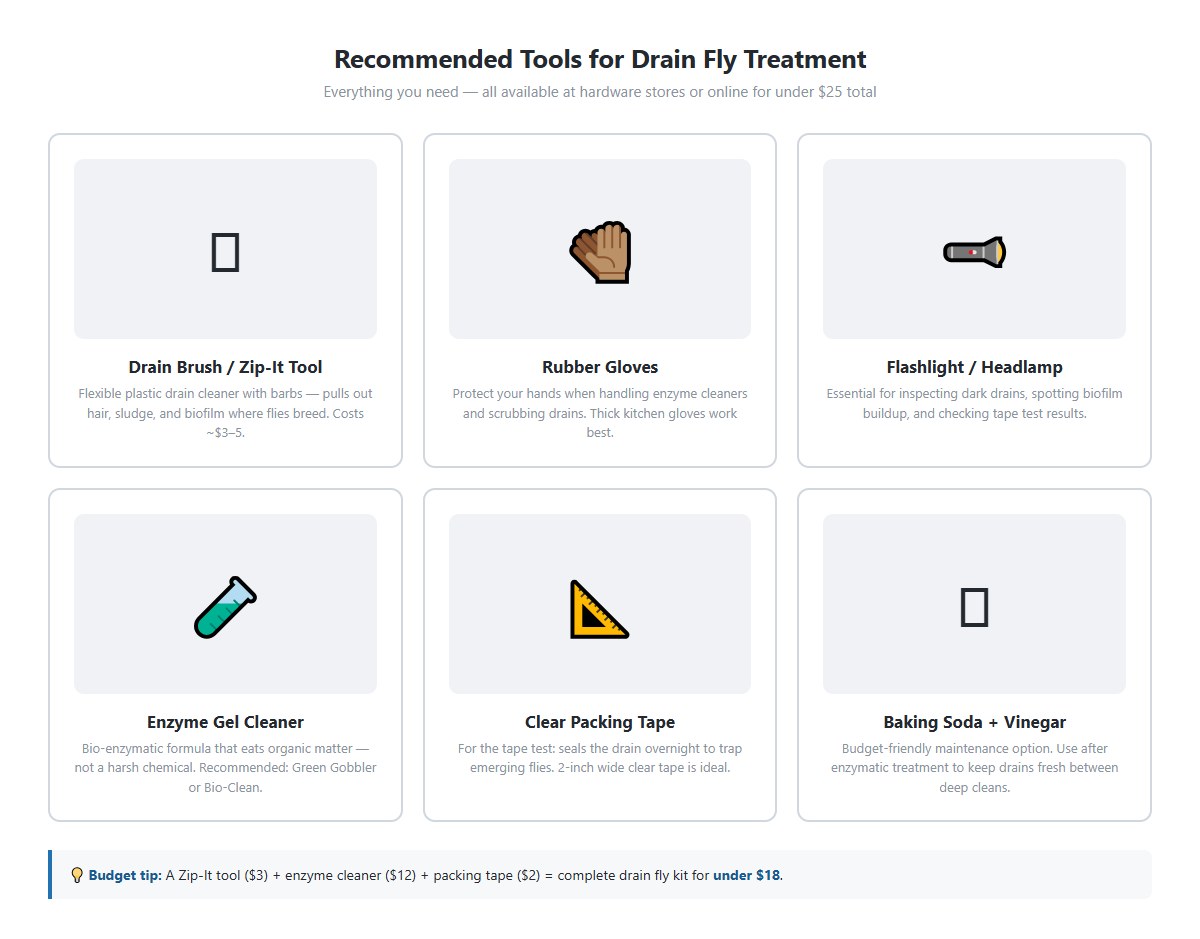
What You Need
- A **drain brush** or bottle brush (long, flexible handle)
- A **plumber’s snake** or zip-it drain cleaning tool (for hair clogs)
- **Rubber gloves**
- A **bucket**
- A **flashlight**
Cleaning Procedure
- **Remove the drain cover.** Most screw off or pop off with a flathead
screwdriver.
- **Pull out visible debris.** Use the zip-it tool to extract hair clumps.
This alone often removes 50%+ of the breeding medium.
- **Scrub the pipe walls.** Insert the drain brush and vigorously scrub the
inside of the pipe, especially the first 6–12 inches below the drain opening.
Rotate the brush as you move it up and down.
- **Rinse with hot water.** Run the hottest water your tap produces for 3–5
minutes to flush out dislodged material.
- **Repeat for every drain** in the affected room. If you found flies in the
bathroom, clean ALL bathroom drains — sink, shower, and tub.
> **Safety Note**: If using chemical cleaners after this step, ensure the drain
> is thoroughly flushed with water first. Some drain cleaning products react
> dangerously with other chemicals.
Step 2: Eliminate Remaining Larvae and Eggs
After physical cleaning, you need to kill any remaining eggs and larvae in the
pipe. You have three options, ranked by effectiveness.
Option A: Enzyme Drain Cleaners (Recommended)
Enzyme cleaners use bacteria and enzymes to digest the organic film. They are:
- **The most effective long-term solution** — they eat the breeding medium
- **Safe for pipes** — no corrosive chemicals
- **Safe for septic systems**
| Product | Form | Application | Approx. Price |
| Green Gobbler Drain Clog Dissolver | Liquid gel | Pour, let sit 4–8 hrs | ~$12 |
| Bio-Clean Drain Septic Bacteria | Powder | Mix with water, pour, sit 6–8 hrs | ~$50 (2 lb) |
| Drainbo Natural Drain Cleaner | Liquid | Pour, sit 4–8 hrs | ~$15 |
| Zep Drain Defense | Liquid | Pour, sit 2–4 hrs | ~$10 |
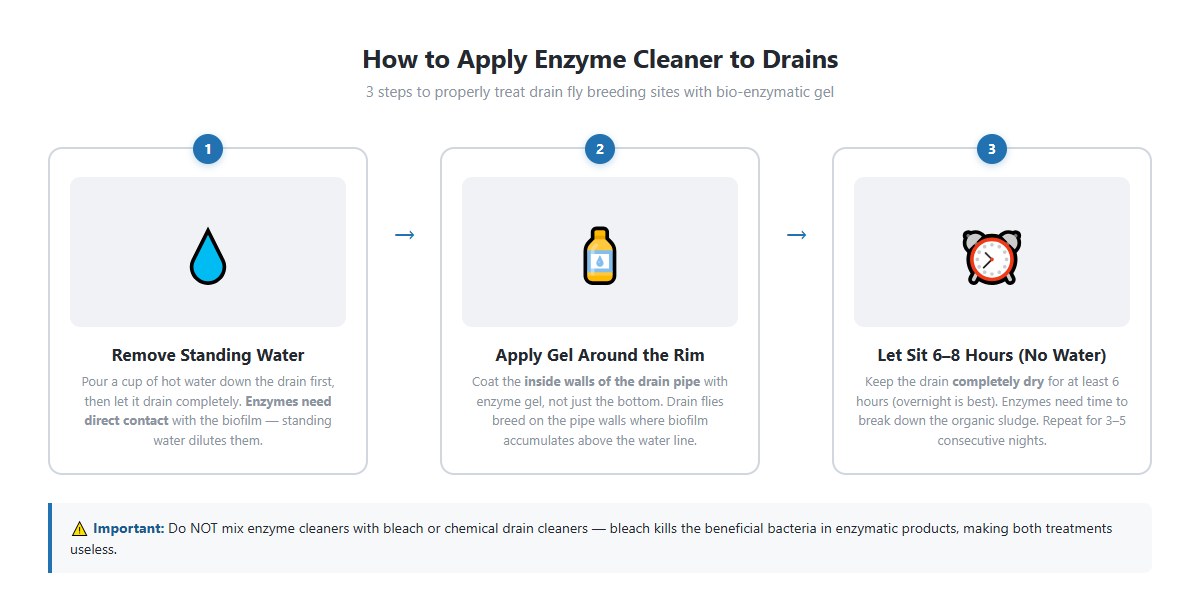
**How to apply enzyme cleaners for drain flies:**
- Apply the product at night, when drains won’t be used for 6–8 hours
- Pour the specified amount directly into the drain
- Do NOT run water — you want the product to sit in the pipe and work
- In the morning, flush with hot water for 2–3 minutes
- Repeat for 3–5 consecutive nights
Option B: Boiling Water + Vinegar + Baking Soda
If you prefer a non-commercial approach:
- Pour 1/2 cup baking soda down the drain
- Follow with 1 cup white vinegar — it will fizz vigorously
- Let the fizzing work for 10–15 minutes
- Flush with a full pot (2–3 quarts) of boiling water
- Repeat daily for 3–5 days
**Limitations**: This method is less effective than enzyme cleaners for heavy
infestations. The fizzing action is brief, and baking soda/vinegar won’t
penetrate thick sludge as effectively. Use this for minor problems or as a
maintenance routine.
Option C: Bleach (Use With Caution)
Bleach *can* kill drain fly larvae, but it has major drawbacks:
- **Does not remove the sludge** — flies will return when the bleach dissipates
- **Damages pipes** over time (especially older metal pipes)
- **Dangerous** if mixed with other cleaning products (produces toxic chlorine gas)
- **Kills beneficial bacteria** in septic systems
- **Corrosive** to some drain cover finishes
> **Safety Warning**: Never mix bleach with ammonia, vinegar, or any acid-based
> cleaner. The combination produces toxic gases that can cause serious
> respiratory injury. If you use bleach, flush the drain thoroughly with water
> before and after, and never use it immediately after other cleaning products.
**If you use bleach**: Dilute 1 part bleach with 10 parts water. Pour into
drain. Let sit for 5 minutes **maximum**. Flush with hot water for 3–5 minutes.
Open windows for ventilation.
Step 3: Prevent Future Infestations
Once you’ve eliminated the current infestation, prevent recurrence with these
maintenance habits.
Weekly Maintenance
- Flush all drains with **hot water** for 1–2 minutes
- Use a drain brush on bathroom drains once a week (takes 30 seconds)
Monthly Maintenance
- Apply an enzyme drain cleaner treatment overnight once per month
- Or: Baking soda + vinegar treatment followed by boiling water
Fix Underlying Problems
| Problem | Solution |
| Hair constantly clogging drains | Install a hair catcher/strainer ($5–10) |
|---|---|
| Slow-draining sink | Clear the P-trap or snake the drain |
| Unused floor drain | Pour water into it weekly to keep the P-trap filled |
| Leaky pipes creating standing water | Repair the leak — this is non-negotiable |
| AC condensate line clogged | Have it professionally cleaned annually |
Products That Help Prevent Recurrence
**[AFFILIATE: Product recommendations for drain maintenance]**
- **Hair catchers/strainers**: $5–$10, the simplest and most effective prevention
- **Enzyme drain maintenance sticks**: Monthly slow-release sticks that keep
organic buildup in check
- **Drain brushes**: Buy once, use for years. A 24-inch flexible brush covers
bathroom sink and shower drains.
When to Call a Professional
Most drain fly infestations can be solved with the steps above. Call a plumber
or pest control professional if:
- You’ve followed all steps consistently for 2+ weeks with no improvement
- The drain flies keep appearing in multiple rooms despite treatment
- You suspect a broken sewer line or drain pipe (signs: sewage smell, wet spots
on walls/floors, multiple drains backing up)
- You cannot locate the breeding source despite systematic testing
A plumber can camera-inspect your pipes to find hidden breaks, leaks, or
organic buildup in inaccessible sections. Pest control professionals can apply
commercial-grade biological treatments that go deeper than consumer products.
Common Mistakes That Make Drain Flies Worse
| Mistake | Why It Fails | What to Do Instead |
| Spraying adult flies with insecticide | Doesn’t touch the breeding source; 200 new eggs are waiting in the drain | Focus on cleaning the drain, not killing adults |
|---|---|---|
| Pouring boiling water without cleaning first | Boiling water alone won’t remove the sludge film | Scrub first, then flush |
| Treating only one drain | Drain flies can breed in any drain in the room | Treat ALL drains in the affected area |
| Giving up after 2–3 days | Eggs continue hatching; you need to break the full life cycle | Continue treatment for at least 7–10 days |
| Using drain gel on a dry drain | The gel needs to coat the pipe walls to work | Run a little water first so the gel distributes evenly |
Summary: The 7-Day Elimination Protocol
| Day | Morning | Evening |
| 1 | Physical cleaning of all drains | Apply enzyme cleaner, no water overnight |
|---|---|---|
| 2 | Hot water flush | Enzyme cleaner |
| 3 | Hot water flush | Enzyme cleaner |
| 4 | Hot water flush | Enzyme cleaner (last application) |
| 5 | Hot water flush | Hot water flush |
| 6 | Inspect for remaining adults | Hot water flush |
| 7 | Final inspection + tape test | If tape is clean → success! If not → repeat days 1–5 |
After Day 7, switch to **weekly hot water flushing + monthly enzyme maintenance**
to keep your drains fly-free permanently.
Frequently Asked Questions
Are drain flies harmful?
Drain flies do not bite, sting, or spread disease directly. However, in large
numbers, they can trigger allergies or asthma in sensitive individuals. The
real concern is that they indicate an unsanitary buildup in your drains — which
can also harbor bacteria and other pests.
How long does it take to get rid of drain flies?
With consistent treatment following this guide: **7–14 days** to fully eliminate
an infestation. Partial treatment (cleaning but no follow-up enzyme applications)
often results in recurrence within 2–3 weeks.
Can drain flies come from the toilet?
Yes, but only if the toilet is rarely used and the water in the bowl or trap
has evaporated or become stagnant. This is more common in guest bathrooms or
vacation homes.
Do drain flies mean my house is dirty?
No — drain flies are attracted to the organic film inside pipes, which forms in
every household drain regardless of overall cleanliness. Even spotless homes
can get drain flies.
Will bleach alone get rid of drain flies?
Temporarily, at best. Bleach kills larvae and eggs on contact but does not
remove the organic sludge they feed on. The flies will return within days
to weeks. Physical cleaning + enzyme treatment is the permanent solution.
Related Guides
- [Drain Flies vs Fruit Flies: How to Tell Them Apart (With Photos)](link)
- [How to Clean Every Drain in Your Home: The Complete Checklist](link)
- [Enzyme Cleaners Explained: What They Are and How They Work](link)
- [Best Drain Fly Killer Products: Enzyme Cleaners Compared](link)
**Safety Notice**: Pest control products, including drain cleaning chemicals,
can be dangerous if used improperly. Always read and follow product label
instructions. Never mix chemical drain cleaners with other products. If you are
unsure about a pest problem or have a severe infestation, consult a licensed
plumber or pest control professional.
**[AFFILIATE DISCLOSURE REMINDER: Ensure Amazon links are properly tagged with
Associate ID]**