**Affiliate Disclosure**: When you buy through links on this page, we may earn
a commission. [Learn more](/affiliate-disclosure/)
**Medical Disclaimer**: This article mentions skin reactions associated with
carpet beetles. This information is for educational purposes only and does not
constitute medical advice. Consult a healthcare provider for any skin
condition.
Carpet beetles are the pest that most people misdiagnose. You notice small,
irregular holes in your wool sweater. You find strange, fuzzy little worms
crawling along the baseboard. Maybe someone in the household develops an
unexplained rash. You might blame moths. You might blame bed bugs. You might
blame the laundry detergent.
But often, the real culprit is the **carpet beetle** — an insect so small and
unassuming that most infestations go unnoticed until significant damage has
already been done.
This guide covers identification, elimination, and prevention for all life
stages: adults, larvae, and eggs.
What Are Carpet Beetles?
Carpet beetles are small beetles in the family **Dermestidae** (from Greek:
*derm* = skin, *este* = to eat — “skin-eaters”). Despite the name, they don’t
just eat carpet. They feed on a wide range of natural fibers and animal-based
materials.
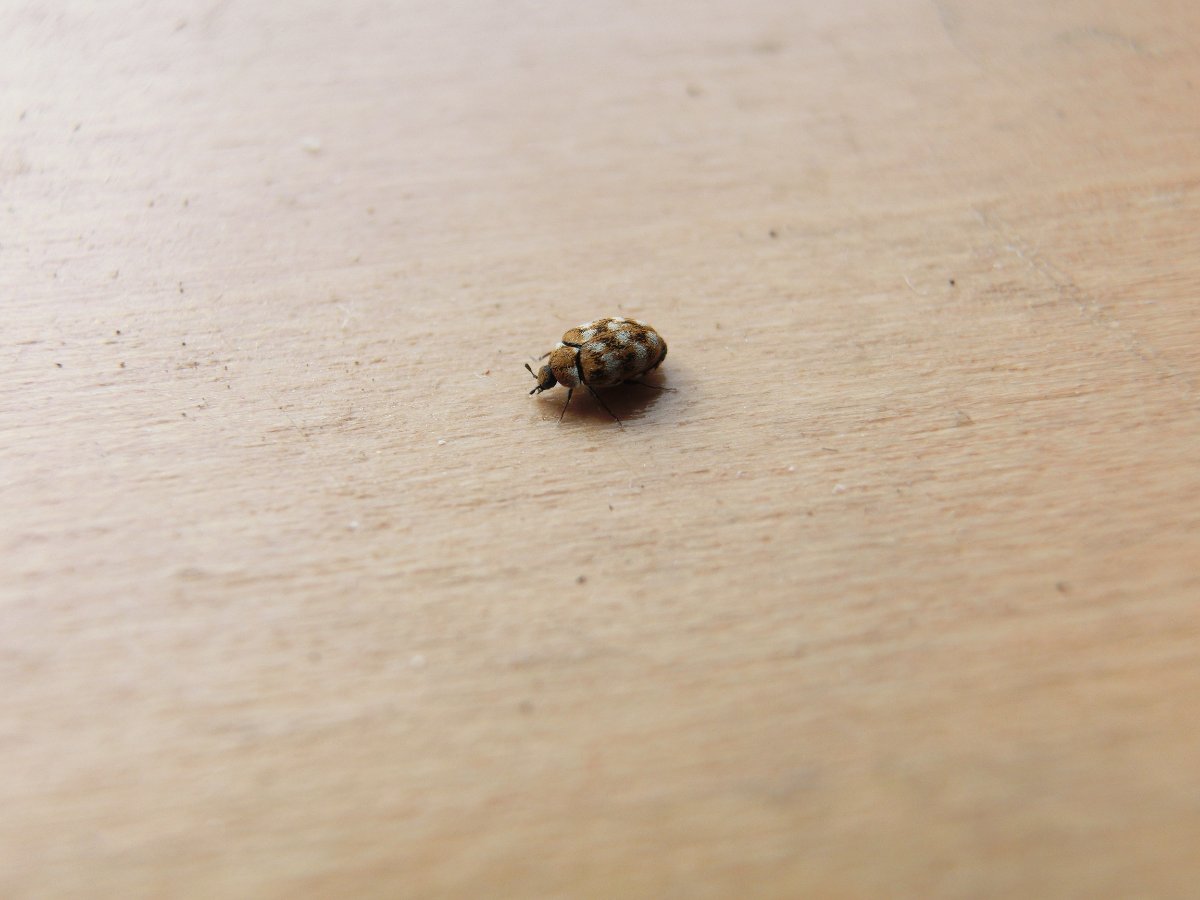
white surface — showing the distinctive mottled pattern of white, brown, and
yellow scales]**
*Caption: Adult varied carpet beetle (Anthrenus verbasci). Note the round body,
mottled coloration, and small size — adults are only 2–4 mm long.*
What They Destroy
| Material | Risk Level | Examples |
| Wool | Very High | Sweaters, suits, blankets, carpets |
|---|---|---|
| Silk | High | Clothing, linens, decorative fabrics |
| Leather | High | Shoes, jackets, furniture, book bindings |
| Fur & feathers | Very High | Coats, down pillows, taxidermy, feather decorations |
| Dead insects | High | Accumulated dead bugs in light fixtures, window sills |
| Pet hair & dander | High | Accumulated under furniture, in air ducts |
| Dried food | Moderate | Spilled pet food, old cereal, improperly stored flour |
| Cotton & linen | Low-Moderate | Only if heavily soiled or blended with wool |
| Synthetic fibers | None | Polyester, nylon, acrylic are not food sources |
The Three Life Stages You Need to Know
Understanding the life cycle is critical because **the larvae do the damage,
not the adults**. Killing adult beetles won’t stop an infestation — the larvae
are already feeding somewhere hidden.
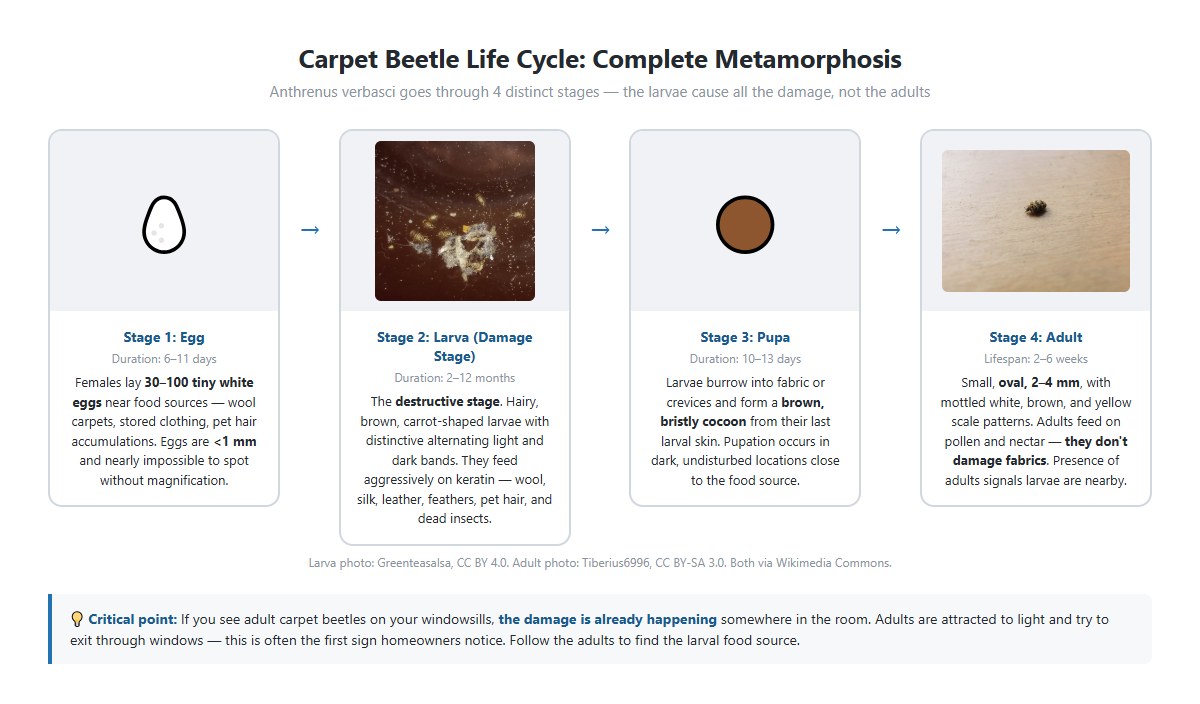
relative sizes next to a penny for scale]**
Stage 1: Adult Beetles
| Feature | Description |
| Size | 2–4 mm (about the size of a grain of rice) |
|---|---|
| Shape | Round or oval, convex (domed) body |
| Color | Mottled pattern of white, brown, yellow, and black scales (varied carpet beetle); solid black (black carpet beetle) |
| Behavior | Attracted to light; often found on windowsills trying to get outside |
| Diet | Pollen and nectar (adults don’t eat fabric — they’re pollinators outdoors) |
| Lifespan | 2–6 weeks as adults; females lay 30–100 eggs during this time |
**Key fact**: Adult carpet beetles on your windowsill means there are larvae
feeding somewhere inside your home. The adults are trying to get outside to
feed on flowers. Focus your search on finding the larvae.
Stage 2: Eggs
| Feature | Description |
| Size | ~0.5 mm (nearly invisible to the naked eye) |
|---|---|
| Color | Creamy white, oval |
| Where laid | In or near larval food sources — wool carpet fibers, fabric folds, animal nests, lint accumulations |
| Hatch time | 6–20 days, depending on temperature |
Stage 3: Larvae (The Real Problem)
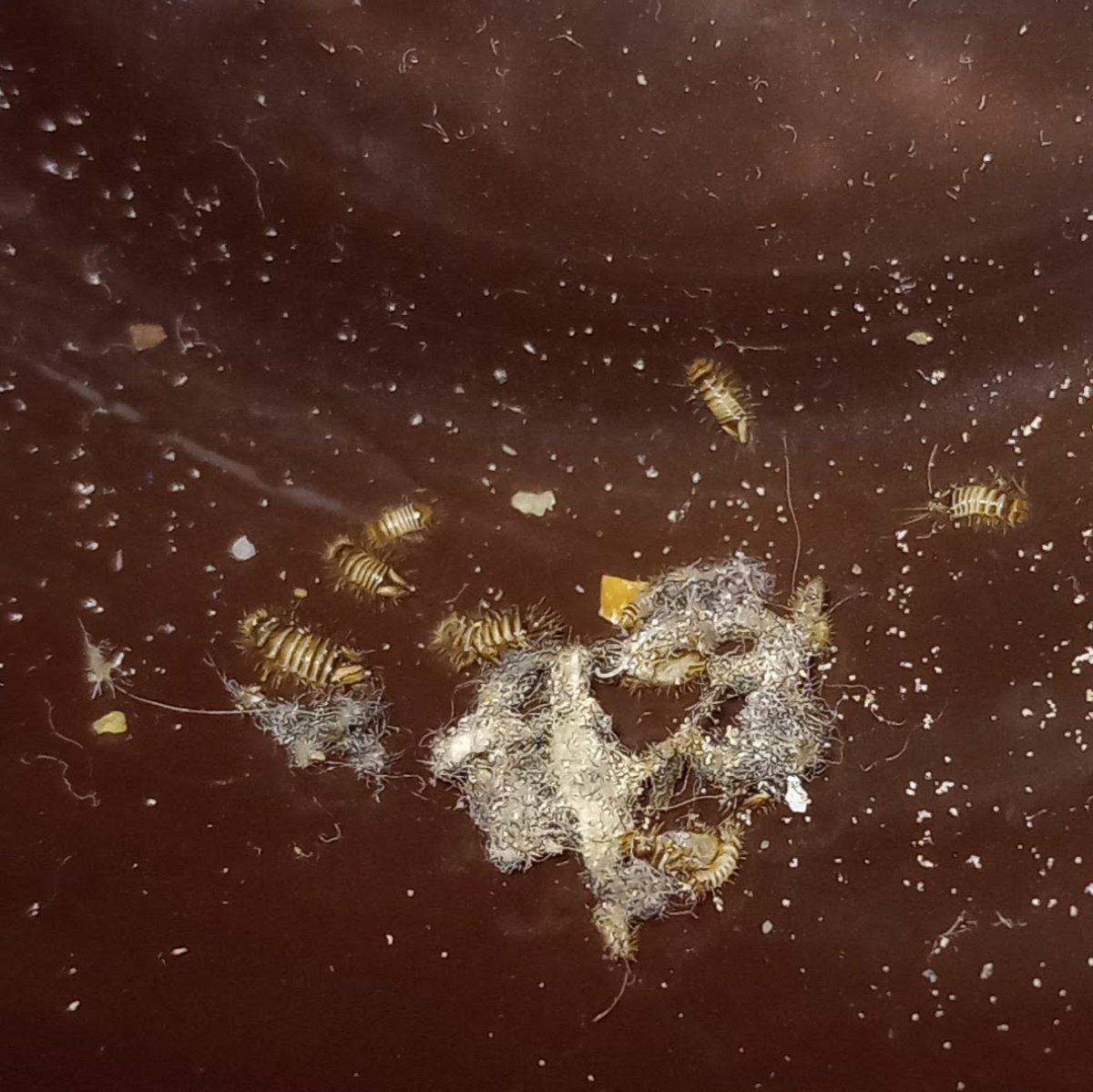
striped body, and bristled tail end]**
*Caption: Carpet beetle larva. This is the damaging stage. Note the dense
bristles/hairs covering the body, the alternating light and dark bands, and
the tuft of longer hairs at the rear. This “fuzzy worm” appearance is very
different from the smooth, teardrop shape of a silverfish.*
| Feature | Description |
| Size | 4–8 mm when fully grown |
|---|---|
| Shape | Elongated, carrot-shaped (wider at front, tapering to rear) |
| Color | Alternating light and dark brown bands; covered in dense bristles/hairs |
| Key identifier | Distinct tuft of longer hairs at the rear end |
| Duration | This is the long stage — larvae feed for 9 months to 2 years depending on conditions |
| Molt | Larvae shed their skin multiple times; shed skins are a key infestation sign |
Are Carpet Beetles Causing That Rash?
Some people develop skin reactions to carpet beetle larvae. This is **not a
bite** — carpet beetles don’t bite humans. The reaction is caused by the
larval hairs (setae), which can:
- Mechanically irritate the skin (like fiberglass)
- Trigger an allergic reaction in sensitive individuals
The resulting rash is often mistaken for bed bug bites, leading to unnecessary
and expensive bed bug treatments. Here’s how to tell the difference:
| Carpet Beetle Reaction | Bed Bug Bites | |
| Pattern | Scattered, random red bumps | Often in lines or clusters of 2–3 |
|---|---|---|
| Location | Anywhere, especially where fabric touches skin | Exposed skin during sleep |
| Timing | Can occur during the day | Primarily nighttime |
| Evidence | No blood spots on sheets; shed larval skins in room | Blood spots on sheets; insects in mattress seams |
| Pest found | Larvae in fabric, baseboards, closets | Bugs in mattress, bed frame, furniture crevices |
**If you have a persistent rash**: Consult a dermatologist. Do not self-diagnose
based solely on internet information. The presence of carpet beetles and a rash
does not automatically mean the beetles are the cause.
Where to Find Carpet Beetle Larvae
Larvae feed in dark, undisturbed areas. Search these locations systematically:
High-Priority Search Areas
| Location | What to Look For |
| Under and behind furniture | Larvae, shed skins, and damaged fabric along the underside of upholstered furniture |
|---|---|
| Carpet edges | Larvae along baseboards, under furniture legs, in corners |
| Closets | Damaged wool, silk, or fur items; larvae in folds and seams |
| Air ducts and vents | Accumulated lint, pet hair, and dead insects — a larval buffet |
| Under large appliances | Refrigerator, stove, washing machine — lint and debris accumulate |
| Attic and basement | Old stored clothing, blankets, taxidermy, insect collections |
Tell-Tale Signs
- **Shed larval skins**: Translucent, bristly, hollow casts left behind as
larvae molt — these look like fuzzy, empty shells
- **Bald patches on wool carpets**: Irregular thinning, especially in dark
corners and under furniture
- **Irregular holes in clothing**: Unlike moth holes (which are clean-edged),
carpet beetle damage often has irregular, fuzzy edges
- **Adult beetles on windowsills**: The #1 early warning sign
Step 1: Locate and Remove Infested Items
Finding and removing the active infestation site is more important than any
chemical treatment.
- **Systematically inspect every location listed above** with a bright
flashlight and a magnifying glass if available
- **Remove and isolate infested items** in sealed plastic bags
- **Heavily infested items**: If the item is not valuable, discard it
(sealed in a plastic bag in outdoor trash)
- **Salvageable items**: Treatment options:
- Dry clean (kills all life stages)
- Hot wash (120°F/49°C minimum) + hot dryer (30+ minutes)
- Freeze (-20°F/-29°C for 72 hours) in sealed plastic bags
- Steam clean (for carpets and upholstery that can’t be laundered)
Step 2: Deep Clean Every Affected Area
Carpet beetle larvae can survive on tiny accumulations of lint, pet hair, and
dead insects. Deep cleaning removes their food supply.
Vacuuming Protocol
- **Use a vacuum with strong suction and a HEPA filter** (carpet beetle hairs
can become airborne allergens)
- Vacuum all carpets, rugs, and upholstered furniture — **slowly**, multiple
passes in different directions
- Use **crevice tools** along baseboards, under furniture, in closets, and
along carpet edges
- Vacuum inside closets, drawers, and storage areas
- **Dispose of the vacuum bag outside immediately** after use (or empty bagless
canister into outdoor trash)
- Repeat weekly during active infestation, then monthly for prevention
Steam Cleaning
Steam is one of the most effective non-chemical treatments:
- Steam reaches temperatures that kill eggs and larvae on contact (> 120°F)
- Effective on carpets, upholstery, mattresses, and curtains
- Particularly useful for wool carpets that can’t be hot-washed
- Rent or buy a steam cleaner; follow manufacturer instructions for fabric safety
**[AFFILIATE: Steam cleaner recommendation]**
Step 3: Treat With Insecticides (Where Needed)
If cleaning alone isn’t enough, targeted insecticide application can eliminate
remaining larvae.
For Carpets and Rugs
**Products containing pyrethroids** (bifenthrin, permethrin, deltamethrin) or
**insect growth regulators (IGRs)** labeled for carpet beetles:
- Apply as a light, even spray along carpet edges, under furniture, and in
corners
- IGRs prevent larvae from developing into reproductive adults — they’re a
good complement to adult-killing insecticides
- Test on an inconspicuous area first to check for staining
**[AFFILIATE: Carpet beetle spray product link]**
For Cracks and Crevices
- **Boric acid powder** or **diatomaceous earth** applied into baseboard gaps,
floor cracks, and wall voids
- These powders remain effective as long as they stay dry
- They work slowly (days, not hours) but provide long-lasting protection
For Closets and Storage
- **Cedar blocks, lavender sachets, or mothballs** for prevention in storage
- Note: These repel but don’t kill existing infestations — use them after
cleaning, not instead of it
> **Safety Warning**: All insecticides are pesticides regulated by the EPA.
> Always read and follow label instructions. Do not apply insecticides to
> clothing, bedding, or surfaces that come into direct contact with skin.
> Keep children and pets away from treated areas until dry. Never use outdoor
> pesticides indoors.
Step 4: Prevent Future Infestations
Storage Prevention
| Item Type | Storage Method |
| Wool clothing | Clean before storing (dirty wool attracts beetles); store in sealed plastic bags or bins with cedar |
|---|---|
| Silk garments | Same as wool — clean, seal, protect |
| Blankets & linens | Vacuum-sealed bags for long-term storage |
| Furs & leather | Professional cold storage for valuable items |
| Dry pet food | Airtight containers — never leave open bags on the floor |
| Important documents | Plastic bins, not cardboard boxes |
Environmental Prevention
- **Reduce indoor flowering plants** near windows — adult beetles feed on
pollen and enter through open windows
- **Install window screens** with fine mesh (20-mesh or finer)
- **Clean window sills regularly** — remove dead insects that accumulate there
- **Seal cracks and gaps** around windows, doors, and utility penetrations
- **Vacuum air vents and ducts annually** to remove accumulated lint and debris
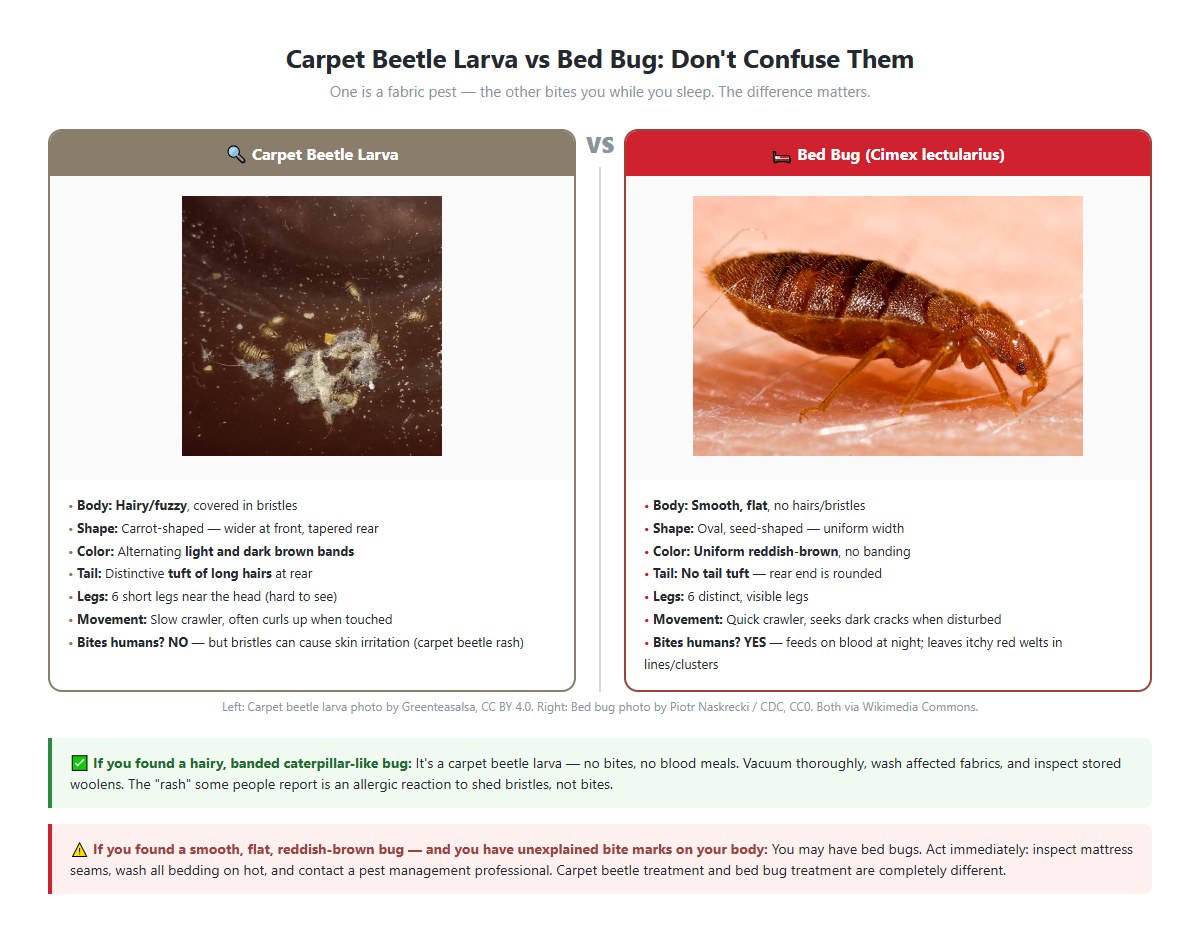
Carpet Beetles vs Bed Bugs: Don’t Make This Mistake
Many people find carpet beetle larvae and immediately assume they have bed bugs.
This mistake leads to expensive, unnecessary bed bug treatments.
| Carpet Beetle Larva | Bed Bug | |
| Appearance | Fuzzy, bristly, carrot-shaped, striped | Flat, oval, reddish-brown, smooth, segmented |
|---|---|---|
| Size | 4–8 mm | 1–7 mm (depending on feeding) |
| Movement | Slow crawling | Crawls quickly when disturbed |
| Found in | Carpets, closets, fabrics, lint accumulations | Mattresses, bed frames, furniture crevices near sleeping areas |
| Bites? | No (larval hairs cause skin irritation in some) | Yes — feeds on human blood |
| Blood spots on sheets? | No | Yes (fecal spots after feeding) |
The 4-Week Carpet Beetle Elimination Protocol
| Week | Focus | Actions |
| Week 1 | Discovery | Inspect all locations; identify and isolate infested items; first deep vacuum |
|---|---|---|
| Week 2 | Treatment | Launder/dry clean/freeze salvageable items; apply DE or boric acid to cracks; steam clean |
| Week 3 | Attack | Targeted insecticide if needed; second deep vacuum; continue monitoring |
| Week 4 | Prevention | Set up storage protection; seal entry points; final inspection |
After Week 4, continue monthly vacuuming of susceptible areas and periodic
inspection of stored natural-fiber items.
When to Call a Professional
Call a licensed pest control professional if:
- Infestation is widespread (multiple rooms with active larvae)
- You have valuable wool rugs, fur, or taxidermy that can’t be replaced
- Infestation persists after 4+ weeks of consistent treatment
- You live in an apartment building where the source may be in another unit
- You’re unable to locate the primary infestation site
Frequently Asked Questions
Do carpet beetles bite?
No. Carpet beetles do not bite humans. The skin irritation some people
experience is caused by contact with the larval hairs, not bites.
Can carpet beetles fly?
Yes. Adult carpet beetles can fly and are attracted to light. This is why
you often find them on windowsills — they’re trying to fly toward the light
and get outside.
How did carpet beetles get into my house?
Most commonly: adult beetles fly in through open windows (attracted to light
and indoor flowers); infested vintage clothing, rugs, or furniture brought in;
or they enter through gaps around windows and doors.
Are carpet beetles seasonal?
Adult activity peaks in spring and early summer (May–July in the Northern
Hemisphere), when adults emerge to feed on pollen outdoors. Larvae are active
year-round indoors.
Can carpet beetles live in synthetic carpet?
They can’t eat synthetic fibers, but they can survive on the lint, pet hair,
and food debris that accumulate in any carpet. Even “synthetic-only” homes
can have carpet beetles if there’s enough organic debris in the carpet.
Related Guides
- [Carpet Beetle Larvae vs Bed Bugs: Visual Comparison Guide](/carpet-beetle-larvae-vs-bed-bug/)
- [Carpet Beetle Rash: Symptoms, Treatment & Prevention](/carpet-beetle-rash/)
- [The Complete Guide to Diatomaceous Earth for Pest Control](/diatomaceous-earth-for-pests/)
- [Home Pest Prevention Checklist](/home-pest-prevention-checklist/)
**Safety Notice**: Pest control products mentioned in this guide are regulated
by the EPA. Always read and follow product label instructions. The label is the
law. Never apply insecticides to surfaces that contact skin, food, or pet areas.
If you are unsure about a pest problem, consult a licensed pest control
professional.